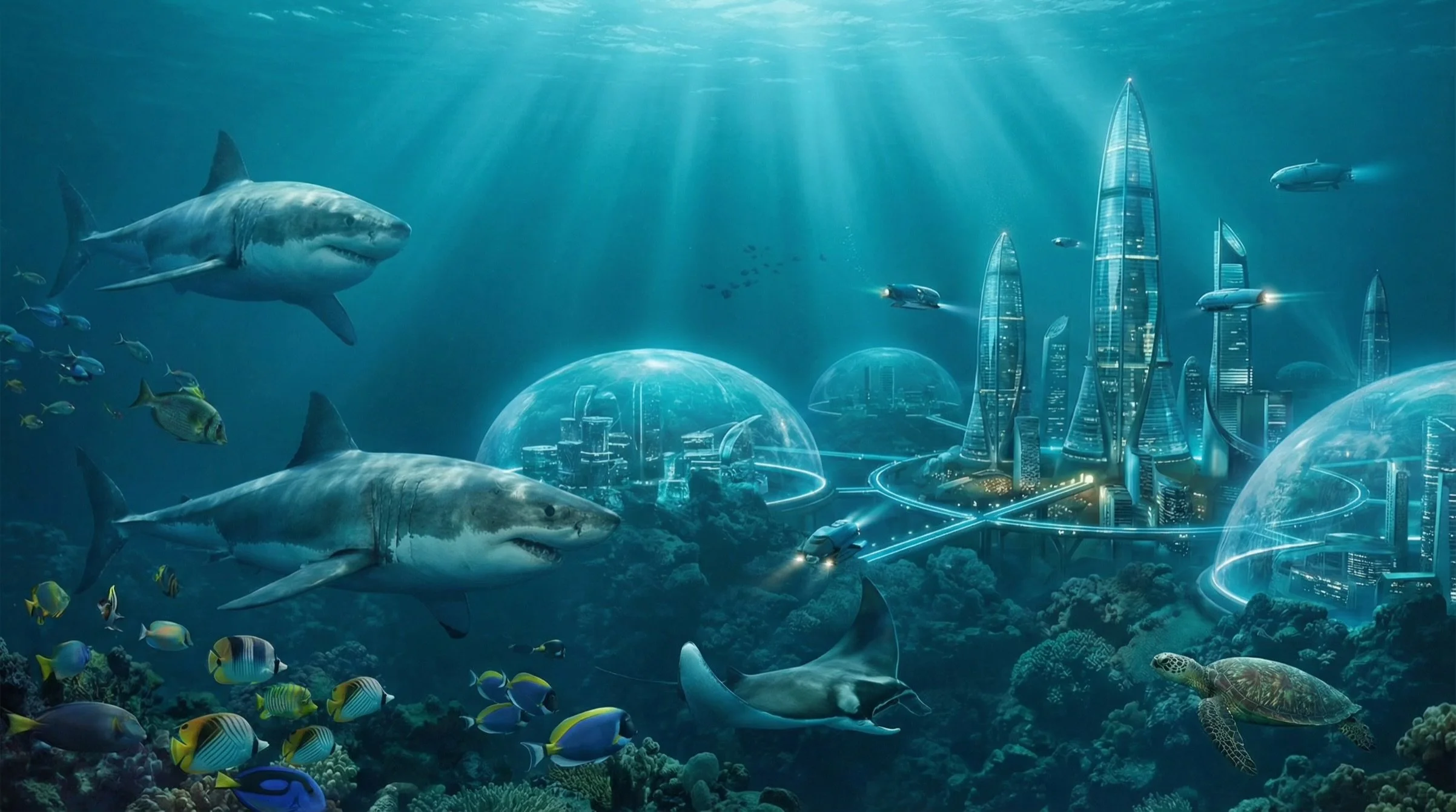
The Sea and the Savanna
An Extension of the Doctrine of Correspondence
The concept of The Sea and the Savanna emerges as a natural extension of the Doctrine of Correspondence. It articulates the dynamic equilibrium—the cosmic see-saw—between the material and spiritual poles that shape the great cycles of time known as the Celestial Ages, each aligned with a phase of the precession of the equinoxes. Rather than privileging one pole over the other, this framework reveals a lawful alternation of dominance, governed not by moral hierarchy but by environmental alignment.
The Two Poles of the Ages
Within this model, the Sea represents the material pole, while the Savanna represents the spiritual pole. Both are essential expressions of existence, neither inherently superior, and each governed by its own internal ecology—its own pressures, rewards, and forms of life that flourish under its conditions. Just as species evolve traits suited to their habitats, civilizations and individuals develop temperaments, ideologies, and values aligned with the prevailing cosmic “climate” of their age.
Although both environments are arenas of competition and survival, the nature of adaptation differs. The Sea is dense, layered, and opaque. Survival within it depends on navigating complexity, tolerating pressure, and responding to unseen forces—an apt symbol for material epochs characterized by systems, infrastructure, and abstraction. The Savanna, by contrast, is open and exposed. Success depends on vitality, endurance, cooperation, and clarity under full visibility—qualities emblematic of spiritually oriented ages, where awareness and presence are paramount. Both are tests of fitness, but they reward fundamentally different capacities.
Specialization and the Law of Environment
This correspondence is most clearly illustrated through the principle of specialization. Consider two apex creatures native to these domains: the Lion of the Savanna and the Great White Shark of the Sea. Each is a flawless expression of adaptation within its environment—and each is catastrophically unsuited to the other.
The Lion embodies terrestrial sovereignty through courage, agility, strength, and social coordination. Its physical form and instincts are perfectly calibrated for life on open land. Yet these same adaptations would render it helpless in the ocean. Its mass would pull it downward, its claws would provide no propulsion, and its instincts would betray it in an alien medium. Stripped of environmental compatibility, its majesty would dissolve into vulnerability.
The Great White Shark mirrors this truth in reverse. As a marine predator, it is a masterpiece of hydrodynamic efficiency and sensory dominance. Yet removed from water, its evolutionary genius becomes a liability. Its gills fail, its structure collapses under gravity, and its supremacy evaporates. Excellence, divorced from environment, becomes impotence.
The Metaphysical Parallel
This same law governs human consciousness across epochs. Each Celestial Age favors certain modes of being while marginalizing others. In materially oriented ages—analogous to the Sea—those aligned with empirical thinking, technical mastery, and utilitarian logic tend to rise. Individuals oriented toward spiritual, symbolic, or transcendent pursuits may struggle to gain traction, not due to deficiency, but due to misalignment.
Conversely, in spiritually emphasized ages—the Savanna—those who cultivate inner vision, moral refinement, and expressive vitality flourish, while purely material or mechanistic orientations often falter. The determining factor is not intrinsic worth, but environmental resonance.
The Present Transition and the Displacement of Types
Humanity is presently transitioning into the Age of Aquarius, the sign opposite Leo. In the logic of correspondence, Aquarius governs collective systems, abstraction, technology, and networked intelligence—attributes aligned with the vast, interconnected Sea. Leo, by contrast, governs individuality, creative sovereignty, vitality, and personal radiance—the open terrain of the Savanna.
As a result, individuals and cultures marked by strong Leonine qualities often experience modern conditions as restrictive or alien. Traits once celebrated—personal authority, embodied presence, heart-centered leadership—are increasingly sidelined in favor of collective uniformity and systemic integration. They are, metaphorically, Lions navigating an age of Sharks.
Those aligned with Aquarian archetypes—innovation, detachment, collectivism, and intellectual abstraction—find the present era congenial. Their capacities are rewarded because they correspond to the dominant environment.
The Adaptive Principle
Yet specialization carries inherent risk. Just as environments shift, so too do the Ages. The being or civilization that perfects itself exclusively for one pole becomes fragile when the cycle turns. The more complete the adaptation, the greater the vulnerability to reversal.
The ideal, therefore, is not rigid specialization but balance: the capacity to operate across domains. The individual or culture that cultivates both material competence and spiritual insight becomes amphibious—capable of navigating rising tides and exposed ground alike.
Africa, Material Ascendancy, and Cyclical Dominance
The dynamic of the Sea and the Savanna is particularly visible in the historical relationship between Africa and the modern material world shaped largely by European and East Asian development. Africa bears clear signatures of a prior epoch in which life-force and spiritual energies were foregrounded: extraordinary mineral abundance, immense biodiversity, and populations marked by vitality, rhythm, expressiveness, and embodied presence.
As the current age has shifted toward material consolidation—aligned with Saturnian principles of structure, extraction, and system-building—Africa’s resources have increasingly been drawn outward to sustain the construction of the modern material order. Cultures historically resonant with discipline, organization, and technological mastery have become the primary agents of this phase. In this sense, Africa’s material wealth has been instrumental in enabling the rise of what may be described as Saturn’s kingdom: a dense, engineered, and highly stratified material world which, in the analogy of the Sea and the Savanna, represents the Sea.
This pattern does not indicate deficiency. It reflects a lawful alternation of dominance. Africa’s vitality and expressive force have not vanished; they are simply not centered within the prevailing environmental conditions. As with the Lion in the ocean, displacement arises from misalignment, not weakness. When the cycle turns, so too does the locus of ascendancy.
Conclusion
The Sea and the Savanna is not merely an ecological metaphor but a cosmological law describing the relationship between environment, adaptation, and consciousness through time. Each Age functions as an ecosystem of values. To thrive within it requires not only strength, but correspondence.
Just as the Lion and the Shark embody opposing extremes of specialization, human civilizations oscillate between spiritual and material poles, each cultivated until balance demands restoration. The wisdom of the Doctrine of Correspondence relates the mundane to the celestial, the micro to the macro, and the “as below” to the “as above.”
By Instructor Lang
© 2025 The Lang Initiative. All rights reserved.