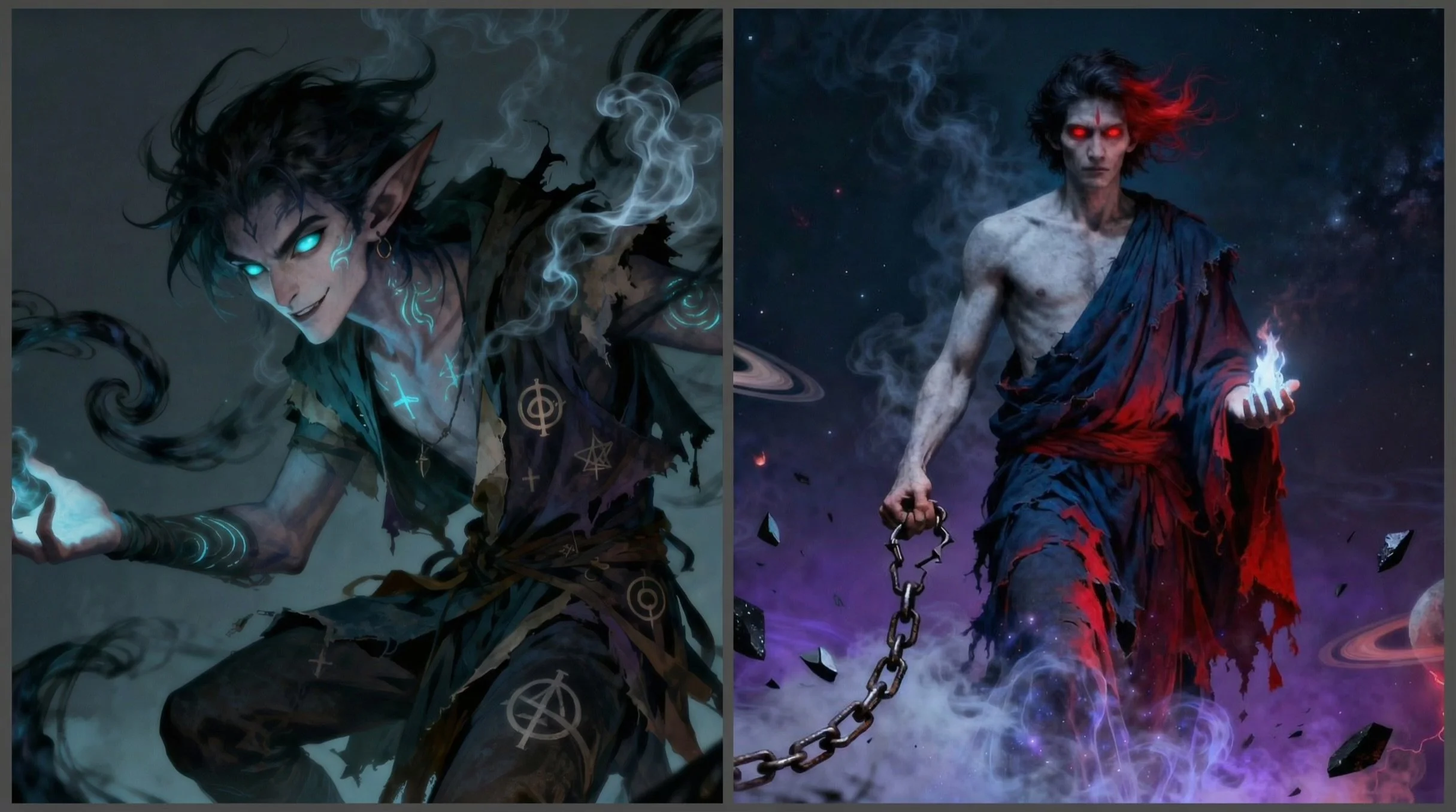
Rahu did it!
In Western astrology, the North Node is often described as the point signifying a person’s purpose or destiny in life. While this interpretation carries a certain appeal, it fails to capture the full scope and complexity of its influence. To say that the North Node merely represents “life purpose” does not do it justice. Its effects are far more intricate, and they are better understood through the Vedic concept of Rahu.
The name Rahu itself evokes mischief and restlessness — an unending hunger that can never be fully satisfied. It represents desire in its most unrefined form: a compulsive drive toward material gain, recognition, or experience. The term “North Node” gives little indication of this quality, yet it is precisely this restless, consuming nature that defines Rahu.
Rahu is not a mere mathematical point but a powerful force — one that operates primarily through illusion and appetite. Rahu’s domain is the material world, and because his hunger is insatiable, he often resorts to deception, manipulation, or subtle forms of trickery to achieve his aims. He governs ambition without restraint, success pursued without reflection, and pleasure sought without peace.
In consultation, if one limits the description of Rahu to simply “where the native must focus their purpose,” much of the picture is lost. Rahu’s influence is not only directional but disruptive. It is the force that pushes the native toward experiences that challenge their integrity and test their wisdom. It can generate circumstances that tempt the individual to abandon truth for expediency — to chase illusion in pursuit of desire.
Therefore, the astrologer must warn that Rahu can bring both progress and peril. The native should be counseled to meet Rahu’s impulses with honesty and restraint — to resist the urge to gain through falsehood, even when deceit seems to promise reward. This is critical, for Rahu’s lessons are often learned through failure; his gifts rarely endure when obtained through dishonesty or excess.
Rahu’s influence becomes particularly volatile when it forms conjunctions with other planets, especially the Sun and Moon. When united with the Sun, Rahu eclipses clarity of self, distorting confidence into arrogance and ambition into obsession. The native may become intoxicated with the desire for recognition, craving validation to an unhealthy degree. This combination often produces a struggle between integrity and ego — between the true light of consciousness and Rahu’s shadow of self-deception.
When conjoined with the Moon, Rahu unsettles the mind and emotions. The native may experience waves of anxiety, confusion, or compulsive thought. The emotions become magnified yet ungrounded, leading to mood instability or exaggerated desires that obscure reason. Rahu with the Moon can make imagination powerful, but also dangerous, as fantasy and reality begin to blur. These combinations — known in Vedic tradition as solar and lunar eclipses — symbolize the temporary triumph of illusion over light and serve as potent reminders of Rahu’s ability to obscure truth until deeper understanding is attained.
At a certain point, Rahu even offers a convenient excuse. When his pressure becomes overwhelming, it is tempting to step aside from responsibility and say, almost jokingly, “Rahu did it!” I didn’t design the scheme that spiraled out of control—Rahu did it! I didn’t spin half-truths to keep a failing endeavor alive—Rahu did it! I didn’t exaggerate, embellish, or curate a version of myself that wasn’t real—Rahu did! In moments like these, Rahu’s influence feels so persuasive that accountability seems optional. Yet this, too, is part of the lesson. Rahu does not act in our place; he amplifies desire until it becomes easier to surrender judgment than to exercise it. The danger lies not in acknowledging Rahu’s pull, but in mistaking pressure for permission.
Whether one calls it the North Node or Rahu, the principle remains: this is a point of both fascination and danger. It magnifies desire until it becomes impossible to ignore, compelling the individual to confront their attachments. In doing so, Rahu ultimately serves a higher purpose — not to punish, but to reveal the folly of illusion and the necessity of truth. When mastered, Rahu becomes a source of worldly success guided by inner clarity rather than by compulsion. But until then, he remains the mischievous teacher who ensures that no unearned victory lasts for long.
Ketu — The Shadow Beyond Desire
If Rahu represents desire reaching outward into the material world, Ketu represents the inward turning of that same energy — the withdrawal from illusion and the search for truth. Together they form the two ends of one axis: Rahu compels engagement, while Ketu compels release. Where Rahu multiplies appetite, Ketu dissolves it; where Rahu seeks experience, Ketu seeks understanding.
Ketu is the shadow of detachment. He governs the process by which the soul becomes disenchanted with the transient and begins to perceive the eternal. If Rahu symbolizes the illusion of gain, Ketu reveals the futility of possession. This is why Ketu is often associated with loss — not as punishment, but as purification. The worldly things taken away under Ketu’s influence are seldom essential to the soul’s growth; rather, their removal exposes what is genuine beneath the attachments.
Psychologically, Ketu may produce feelings of isolation, alienation, or inner restlessness. The native may withdraw from society or feel misunderstood, as though the outer world no longer satisfies. These sensations can be painful, but they carry purpose. Ketu severs ties that have fulfilled their karmic use, clearing space for insight. In this way, he is both destroyer and liberator — the silent counterpart to Rahu’s noisy ambition.
When conjoined with the Sun, Ketu eclipses worldly authority and ego identity. The individual may struggle to define themselves through conventional means and is often drawn to spiritual or intellectual pursuits that transcend social validation. With the Moon, Ketu can bring emotional detachment or sensitivity that borders on transcendence. The native may possess profound intuition, even psychic insight, but may also wrestle with loneliness or difficulty relating to others.
When Ketu joins Venus, the effects are among the most paradoxical. Venus governs pleasure, beauty, affection, and relationship — all things that bind the soul to the sensory world. Ketu, in contrast, dissolves attachment to those very things. When the two unite, the native’s experience of love, comfort, and artistic joy becomes tinged with impermanence. There may be deep yearning for affection yet simultaneous disinterest in maintaining it. Emotional bonds can feel elusive; relationships may begin intensely but fade without clear reason. In material terms, this conjunction can diminish sensual enjoyment or create dissatisfaction even in abundance — as though the heart seeks something that the physical world cannot provide. Yet beneath these challenges lies spiritual potential: Ketu with Venus can refine the native’s appreciation of love from a personal to a transcendent level, shifting desire from the outer form to the inner essence of beauty itself.
These manifestations reveal Ketu’s paradoxical nature: he awakens awareness by removing what once seemed vital. While Rahu pulls consciousness outward toward form, Ketu pulls it inward toward essence. The tension between them defines the human experience — the eternal oscillation between craving and renunciation, between immersion in the world and the longing to be free of it.
Ultimately, Ketu completes Rahu’s lesson. Where Rahu teaches through indulgence, Ketu teaches through emptiness. Together they describe the full arc of experience — from desire to disillusionment, from illusion to enlightenment. To understand one without the other is to see only half the picture. For in the language of the heavens, Rahu and Ketu are not enemies but mirrors: two shadows through which the light of consciousness discovers itself.
The Importance of Accurate Description
It is of utmost importance that the Nodes be described with precision and depth. Simplistic explanations — such as the Western notion of the North Node merely representing “life purpose” and the South Node “past karma” — leave vast portions of a native’s life unaddressed. These are not minor symbolic points but dynamic forces that shape experience in ways both subtle and profound.
When interpreted without nuance, the Nodes’ true influence is overlooked. They act as invisible engines of evolution, capable of magnifying desire, confusion, loss, or transformation far beyond the reach of any other planetary body. Their impact is most pronounced when either Rahu or Ketu form major aspects with planets or significant points such as the Ascendant, Midheaven, or chart rulers. These combinations can redirect the entire trajectory of a native’s life, altering personality, motivation, and destiny itself.
A proper understanding of Rahu and Ketu allows the practitioner to perceive the deeper architecture of human development — the alternating tides of involvement and release, attachment and awakening. Without such understanding, interpretation remains surface-level and misleading. The accurate study of the Nodes is therefore essential not only for predictive precision but for genuine insight into the soul’s unfolding path.
By Instructor Lang
© 2025 The Lang Initiative. All rights reserved.