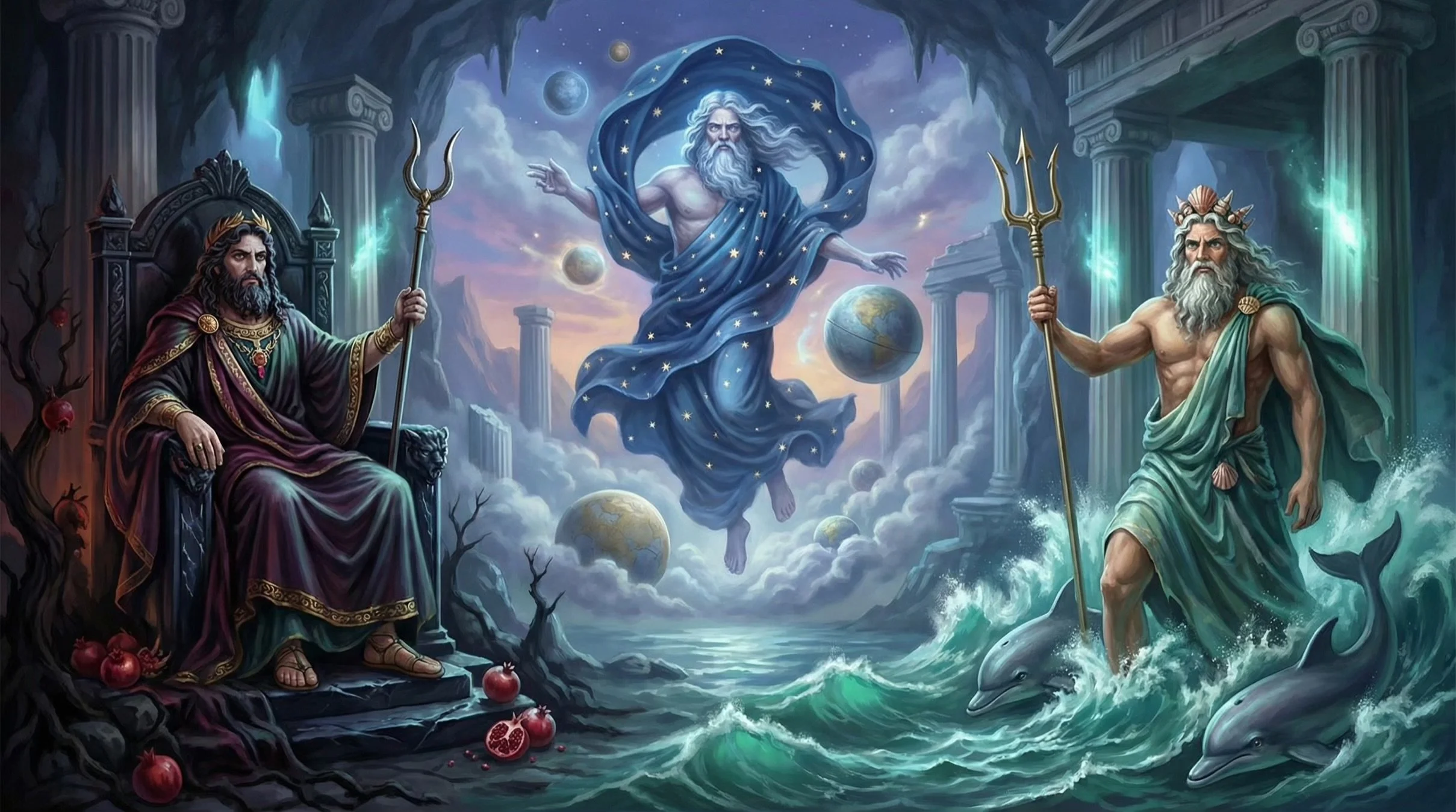
Pluto, Uranus and Neptune
Vedic astrology traditionally recognizes nine planetary influences, or navagrahas: the Sun, Moon, Mercury, Venus, Mars, Jupiter, Saturn, Rahu, and Ketu. These nine form the classical foundation of astrological analysis within the Vedic paradigm. Yet, for a comprehensive understanding of the human energetic constitution, it is necessary to extend one’s examination to include the three trans-Saturnian bodies acknowledged in tropical astrology—Pluto, Uranus, and Neptune. Each operates as a distinct planetary force whose influence, though subtle and often generational, is nonetheless measurable and experientially verifiable.
When these outer planets are excluded from chart interpretation, a significant portion of the native’s lived reality remains unaccounted for. Their absence leaves interpretive gaps—periods of crisis, transformation, or awakening that cannot be logically explained by the traditional nine alone. For instance, when Pluto is conjunct the Ascendant, the native’s character acquires an unmistakable tone of intensity and psychological depth. A Sagittarius Ascendant, typically associated with optimism, expansiveness, and philosophical disposition, becomes notably transformed under Pluto’s influence. Such an individual often encounters life through cycles of destruction and renewal, secrecy, and profound internal change. The persona exhibits traits more consistent with the Plutonian archetype—penetrative insight, endurance, and confrontation with hidden forces—than with the straightforward joviality attributed to Sagittarius. Without acknowledgment of Pluto, this altered energetic expression would remain inexplicable.
A similar logic applies to Uranus and Neptune, whose influences are equally transformative yet distinct in character. Uranus, when conjunct or in close aspect to the Ascendant or Midheaven, imparts qualities of independence, originality, and unpredictability. It awakens an unrelenting drive toward liberation from convention. Such a placement frequently manifests in individuals who act as innovators, reformers, or disruptors within their respective environments. Their lives tend to unfold in sudden shifts, breakthroughs, and moments of radical insight—all hallmarks of Uranian activity.
Neptune, conversely, operates through dissolution and permeability. Its contact with personal planets—particularly the Moon—introduces heightened sensitivity, imagination, and receptivity to the unseen. A Moon–Neptune conjunction, for example, signifies an emotional temperament inclined toward idealism, compassion, and sometimes escapism. The boundaries between self and environment blur; the native becomes more attuned to intuition and spiritual influence but may also wrestle with confusion or disillusionment. These characteristics cannot be accounted for solely through the lunar sign or house placement.
It must also be noted that the influence of the outer planets is not limited to conjunctions alone. Trines, sextiles, oppositions, and squares all convey their modifying effect, each producing a distinct variation in the manifestation of energy. Regardless of aspect, the presence of Pluto, Uranus, or Neptune invariably colors the expression of the planet involved. Even when not in close contact, their effects can be observed as background currents—forces that shape the psychological tone of a lifetime.
Historically, it is remarkable that these planets were initially met with skepticism upon their discovery. One might expect that the recognition of previously unseen celestial bodies—each corresponding to traits and behaviors long observed but unexplained—would have been received as a moment of revelation. Yet, debates persisted as to whether these planets influenced terrestrial life at all. With the benefit of modern observation, such hesitation appears unfounded. The empirical evidence of their influence, when systematically studied, is irrefutable.
Therefore, any authentic system of celestial interpretation—whether Vedic, tropical, or unified under a single empirical framework—must incorporate these trans-Saturnian planets into its analysis. Pluto, Uranus, and Neptune represent the higher octaves of transformation, liberation, and transcendence, respectively. They extend astrological study beyond the visible into the subtle realms of consciousness, illustrating that the celestial order mirrors both the manifest and the unseen dimensions of human existence.
A chart interpretation that neglects these forces remains necessarily incomplete. Only through their inclusion can one grasp the full structure of the native’s energetic design—the total pattern by which inner and outer worlds correspond, evolve, and find coherence under natural law.
By Instructor Lang
© 2025 The Lang Initiative. All rights reserved.